Sunday, May 25, 2014

PIECE BY PIECE...

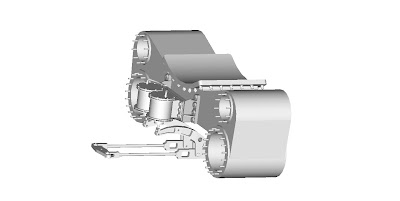
Drawings are now all 3-D, with measurements taken from the completed 2-D engineering drawings.

Each component, part or gadget is separately drawn and then fitted to the master.

Shown below is the Throttle assembly as a separate 3-D drawing.


Mostly finished, the round device is the boiler pressure gauge with no face as of yet.

Neat thing about these drawings is they can be rotated in any axis to view the part from any direction.

That means no cheating on the backside of any view.

I'm thinking that - when the drawings are all done - I might construct a model K-36, maybe 3/4" to the foot.

Won't need new glasses with that scale.

Tuesday, February 25, 2014

SOME NEW STUFF

Things have been hectic to say the least this last year but have settled down to the point I can return to my K-36 drawing effort. (more of a pasttime than an effort)

I purchased a new printer-scanner-plotter, an Epson WF-7520 capable of scanning and printing B size prints. The units were on a closeout sale at one of the office supply outlets for about 20% of the list price. A real bargain, and a great unit.

Below are some "B" sized prints/scans I've been working one lately.


Underview of the K-36

Each component - or sub-assembly - are drawn on separate layers. Most of the layers are turned off in the above print.... brakes, equalizer, etc.


Pilot and snowplow top and bottom views


A bit of the K-36 pictorially


This is all done with  AutoCad 2014, a licensed version which was a gift from my son to keep me occupied. A very expensive gift, but quite appreciated.

The K-36 pictorial version is called "Shades of Gray" by AutoCad . When drawing in 3-D, using the "wire frame", the "shades of gray" is a vital viewport when trying to see where everything is located.

Below is a "wireframe", what I usually see when working a drawing.


Same as the above pictorial, with several more layers turned off.

It's next to impossible to figure out much with a 3-D wireframe.

The top two views are plotted in "hidden" mode, where any lines behind  an object are not drawn.  Also very handy when figuring our where - and what - things are

I'm working on the firebox and cab now.  The backhead is taking a LOT of time and  computer memory.

However, my computer was updated with a 2TB Hard drive, and 4G memory.

No problem.

Sunday, December 16, 2012

READY FOR PUBLISHING, MAYBE


"B" sized pages, most drawings 1/4" scale

Got a proto copy of my book of AutoCad generated drawings of D&RG folio six . The pages are "B" sized, 11 x 17, so almost all the drawings are 1/4" = 1' 0" scale, or "O" gauge.

It's pretty big when opened up, over three feet across.

Included, as bonus drawings,  are some locomotive drawings from the first 2-4-0 through the C-19's,  a couple of the K-36,   locos from the Colorado Southern, the Rio Grande Southern and the Denver, South Park & Pacific.

The hard part is figuring what to do next. Seeing if such a book is even wanted by anyone is step one, and then how to get it published... if warranted.

Even if nobody else wants one, I now have the only book in the world with the greatest concentration of detailed and accurate demensional information on the  D&RG ever assembled under one cover.

This all started when I was a contest modeler in the NMRA, Rio Grande Division and badly needed good dimensional details of the models I was doing.

One of my contest models shown below took a couple years to gather enough information to build a reasonably accurate HOn3 scale model.

First place, passenger cars, 1981 RMR NMRA Denver convention.
(left click to enlarge)
 
As I recall, that model had over 1,000 individual pieces, all hand crafted.

Now that I have all manner of information, my eyes are too bad to do any serious modeling.

That's the way it goes.


Saturday, June 09, 2012

MY LACK OF POSTS

I've upgraded from my older version of AutoCad to AutoCad 2013, and it's a bit like picking up a book to read that's in another language... only partially understood.

In the years between versions, autodesk has changed many many features of it's product, so much so it seems a different product.

I'm sure they consider many of the changes as desirable new bells and whistles, but a lot of them just get in the way of creating a drawing up from ground zero.

The programmers at Autodesk - like so many other programmers - still need to lean the basic rule about "If it works, DON'T FIX IT"!

So, as a result, I'm spending many hours re-learning what I once knew and could use proficiently with yet another "all new and improved" update.

It's probably a better package for all the "improvements", but I'll have to learn about them before I can say they actually help. 2013 seems more like 3D Studio than an engineering drawing package.

I'll post a few more postcards to keep things running.

Tuesday, January 31, 2012

THE K-36 FRONT END (PART OF IT)


I had decided to 3-D the pilot before tackling the backhead under the assumption that it would be easier. Seems I like to fool myself like that more and more. Turns out getting the necessary details on the construction of the pilot, the truck, the snowplow, pilot beam and the host of other little doo-dads was a real challenge.

I'm presently 3-D'ing the coupler... because I enjoy inflicting pain on myself.

Seriously, none of this has been a walk in the park, but I am getting closer to wrapping this project up.

Once again, this is just another "quickie" render, and several layers are not shown, so the snowplow assembly can be more easily seen.

Wednesday, January 04, 2012

MORE ADDITIONS


This is - of course - more of the K-36. The picture is a "quickie" render without all the added point lights to improve contrast and shadow.

Those steampipes from the superheater manifold, what with all those twists and turns, were pretty tricky. They're not perfect, but close enough.

The CAD file is getting huge. 3-D files - if they have a decent number of isolines, get big in a hurry.(Isolines determine the smoothness of a curved surface.)

Monday, December 19, 2011

WHERE THE BRAKE CYLINDERS ARE

Something seldom seen are the brake cylinders on the K-36, they being snugly tucked away between the frame members and under the smoke box. They are mounted on a bracket attached to the engine saddle.


As you can see, they are mounted vertically and require a bit of leverage to direct the braking force in the right direction.

By the use of a pretty nifty mechanical design(not shown), the stopping force generated by the two brake cylinders is applied equally to all eight drivers. When I get the rest of the brake system drawing completed and rendered, I'll post it.

Friday, December 16, 2011

Just a quick post to show that the K-36 tender drawings are nearing completion.


Tuesday, October 18, 2011

FINALLY, A FINISHED ITEM OR THREE

left click to enlarge

This is a completed drawing of three valve gear components on the K36. This rendered drawing is 3-d and can be rotated to view from any angle. All the dimensions are accurate to .0312, or 1/32nd of an inch. This is a good as it will get.

This link yoke was the most difficult component to draw... dozens of different X,Y,Z coordinates for the UCS to create the proper planes for all those curves.

The rest of the valve gear is there, but on different layers that are turned off.

Friday, October 07, 2011

TRAMWAYS, INCLINES, INCLINE RAILWAYS

The Mount Lowe Incline, Pacicic electric Railway, California


This card, mailed from South Pasadena, Calif., on Nov 3, 1906, is 105 years old.


The Pittsbburgh Incline:


Incline Railway up Lookout Mountain, Chattanooga, Tenn.:


This card was mailed August 8, 1907, from Chattanooga, Tenn.


Price's Hill Incline, Cincinnati, Ohio:


This card was never mailed.

Wednesday, October 05, 2011

TERMINALS FROM THE POST CARD COLLECTION

ATLANTA TERMINAL


Atlanta was once the largest rail crossroads in the south. Travelers could get virtually everywhere quickly and conveniently by rail. Built in 1905, this Terminal was the grand portal to the city. It had two Italianate towers and a huge train shed behind. This structure was torn down in 1970, and Atlanta lost a sizable chunk of its architectural history.

Nowadays days Atlanta’s intercity rail depot is a small former commuter rail station located far north of downtown, adjacent to a 16-lane highway.

DENVER TERMINAL


In 1894, most of the central portion of the original 1881 depot was destroyed by fire. A larger replacement depot in the Romanesque style was built in 1891

In 1912, A new central portion, designed by Denver architects Gove & Walsh, was built in the Beaux-Arts style and opened in 1914.

During its heyday, the station served 80 daily trains operated by six different railroads. Today, one daily Amtrak train runs from Chicago to the the Bay Area and passes through this station.

NASHVILLE TERMINAL


Nashville's terminal opened in 1900 to serve the passenger operations of the eight railroads then providing passenger service to Nashville, Tennessee.

The station reached peak usage during World War II when it was the shipping-out point for tens of thousand of U.S. troops and the site of a USO canteen. The formation of Amtrak in 1971 reduced service to the northbound and southbound Floridian train each day. When this service was discontinued in October 1979, the station was abandoned entirely.

RICHMOND TERMINAL


This station, also known as the Broad Street Station, was built as the southern terminus for the Richmond, Fredericksburg and Potomac Railroad (RF&P) in 1917 in the neoclassical style by the architect John Russell Pope.

The station also served the trains of the Atlantic Coast Line Railroad (ACL), the Norfolk and Western Railway (N&W). Eventually, the Seaboard Air Line Railway (SAL), which had formerly used Richmond's other union station (Main Street Station), switched to Broad Street Station.

Passenger service to the station ceased in 1975. The station is now the home of the Science Museum of Virginia.

SOUTH BOSTON TERMINAL


South Station opened as South Central Station on January 1, 1899. It became the busiest station in the country by 1910. A station on the Atlantic Avenue Elevated served the station from 1901 to 1938 and what is now the Red Line subway was extended from Park Street to South Station in 1913. It's train shed(the world's largest) was razed in a 1930 renovation because of corrosion caused by salt air.

South Station was sold to the Boston Redevelopment Authority (BRA) in 1965. Portions of the station were demolished and the land was used to build the Boston South Postal Annex and the Stone and Webster building.

Friday, September 30, 2011

MAIN FRAME OF THE K-36, CENTER SECTION


This is a wireframe view of my 3-D rendition of the K-36, showing only stuff basically below the running boards and without the rear frame and pilot frame. I turned off the layers for the wheels, axles, counterweights and a few other layers so the print would look something besides a mass of undecipherable black ink.

Working on this particular drawing for more than 30 minutes a stretch is a good way to go blind.

I keep asking myself: "Why am I doing this?"

Beats watching TV all day.

Tuesday, September 20, 2011

THE NAMED STREAMLINERS

just a few of many:

CHICAGO AND NORTHWESTERN'S "400"


It's main claim to fame was that it sported a new type of shock absorber that provided a smoother and quieter ride. Seems to me that it would be the rail that did that.

THE CHESAPEAKE AND OHIO'S "500"


This was the world's first coal-burning steam turbine-electric locomotive . It was 154 feet, 9 3/4 inches long, including it's water tender, and had a top speed of 100mph. The engine alone weighed 411 1/2 tons.

Why was it named the "500"? Well... that was 20% better than calling it the "400", shown above.

THE ILLINOIS CENTRAL'S "GREEN DIAMOND"


Adjustable coach seats - indirect lighting - complete air-conditioning - ash trays at every seat - radio in every car - stewardess - registered nurse - beautifully appointed lounge car - delicious inexpensive meals - tickets at ordinary fares.

That's what it says on the back of this card.

NO, the headlight was not referred to as the "Green Lantern".

THE CHICAGO MILWAUKEE ST.PAUL AND PACIFIC'S "HIAWATHAS"


"Haiwathas"? Yes, there was more than one. At the time, they were considered as the most popular trains in the world.

ZEPHYRS

For a long time, I thought that there was only one "ZEPHYR" and that it went between Denver and somewhere else, that it was the only ever train made of stainless steel, and that it was the only one with that unique front end. Silly me. The railroads, like any other company, were quick to jump on a popular concept and ride it into the ground.

A few of the many ZEPHYRS below:


Yes, it's the "Denver and somewhere" ZEPHYR of my childhood days.

Then there's the below ZEPHYR that did not even get near Denver: The Chicago, Omaha and Lincoln unit.


But it looked like what a true ZEPHYR should look like.

Then came along the Texas ZEPHYR:


Definitely not a true streamlined stainless steel ZEPHYR, it was an attempt to cash in on the magic and allure of the ZEPHYR legend. Perhaps those cars were stainless steel, but I'll bet some very serious money(up to a maximum of one federal reserve dollar) that those very ordinary A and B unit diesels were most likely just painted silver.

And then there's those strange people back on the East coast that wanted their very own ZEPHYR, but just couldn't abide calling it what everybody else did, so they named their ZEPHYR the "FLYING YANKEE". Heh... Maybe they were secretly wishing for more airplanes.


This ZEPHYR was owned and operated by the Boston & Maine RR.

I suppose I should be a bit more diplomatic when bringing up Texans and Yankees - since my wife was born and raised in Boston - and we both live in Texas now.

As usual, you can left click to enlarge all the photos.

Wednesday, September 07, 2011

R. P. O. CARDS

I'll post one every now and again...

The Albuquerque & Ashfork RPO:


Ash Fork, Arizona. A few miles west of Williams on U.S. 40. Population in 2007: 573, consisting of 353 males, 220 females. Not a good place for bachelors.


A water and fuel stop for the ATSF, it's apparently a place that never suffered growing pains.

As usual, click on the pics to enlarge.

Sunday, September 04, 2011

NEARNG THE FINISH LINE

Here's a quick print of about 25 layers of the K-36 drawing put together.

Eveything matches up... I'm as suprised as anybody.

Only one layer of dimensions is visible, turn them all on and nothing is readable.


Been a long, long haul doing this.


Saturday, September 03, 2011

TALK ABOUT RUSTIC


The back of the card pretty much says it all...


It's a chuckle to read that this was thought to be the "last of the Western Narrow Gauge".

YEP, THE ZEPHYR WAS IN 1934

Awhile back, I posted a view of some trains at the "Century of Progress Exposition, reposted below:


It prompted this reply from Randy:

Bob, the "Century of Progress" was the 1933/34 world fair held in Chicago, at which the Burlington's Pioneer Zephyr was also introduced. Since your postcard does not have the Zephyr (which was on display during the summer of 1934) I think it's from 1933.

I was recently rummaging through the post card collection and sure enough, there was a card with the Zephyr shown and dated as 1934:


It takes hours to go though the collection just once, so it's not surprising that I missed this card earlier.

I have often thought to index and organize all the cards, but I don't think I have enough time left to to that on top of the other things I'm trying to finish up.

Truthfully, I'm just to lazy to do it.

Thursday, September 01, 2011

MORE ADDED

I've added more to the backhead while at the same time some pipes and fittings have been moved a bit to aid visualization of how and where things are going.

After looking over a lot of my notes and photos of various K-36's, I'm not a bit concerned if what I show is not like any particular locomotive. Seems all of the locos were plumbed any old way handy. My only concern at this point is to make certain (as possible) that the connections are correct.

The backhead so far:
left click to enlarge

I have now positioned it in reference to the cab and frame since many of the items to be added are cab or floor mounted, such as the now added Johnson Bar.

There are still lots of pipes and outlets going nowhere, and the throttle lever is just an outline for position.

The side elevations are coming along... Although a bit slower.

Monday, August 29, 2011

THE K-36 BACKHEAD - PART TWO

The below photo is of 480(As I recall) taken some years ago when it was on the rip track in Chama being used for parts. It does show the haphazard - but successful - methods used by mechanics trying to keep trains running when there was little or no money for the job. The photo shows the Automatic Brake Valve with everything else pretty much stripped away.


As for the drawing:

Working with color and layers helps keep things a bit easier to track. I create layers such as Piping, Fittings, Brackets, Etc., assign different colors to each, and this helps to keep the drawing from becoming a jumble of black lines.


This is all pretty easy at this point, since most of these pipes aren't going anywhere and are not hooked up.


Combining everything so far and we have:


Getting a bit crowded, that's why color helps. There is still a lot of stuff to add... just to this one elevation. And then there's the side elevations and top/bottom views to do yet.

For any purists out there, keep in mind this represents piping routes and fixtures from three different K-36 locomotives, so it does not accurately depict any particular loco.

Nonetheless, it's still a pretty drawing.


Sunday, August 28, 2011

CHASING THE PIPES

It didn't take long to realize that just trying to connect all the piping correctly by looking at a few photographs wasn't going to cut the mustard, so I decided to research the braking systems of the era and settled on a more recent system (circa 1916) that was "designed for any locomotive regardless of its type of service without modification or change, and could be used in any kind of service such as high speed passenger, double pressure control, all ordinary passenger and freight and all switching service without any changes of special adjustments."(1)

The below drawing is of such a system called the ET equipment system. On the surface it appears to be very similar to what I am seeing on the K-36, so for the purposes of creating drawings for my K-36 scale model, this is the system I will employ.


Some items on the K-36, such as the air pump, the airpump governor, the distribution valve, and other components are obviously later versions than those shown in these drawings, but for the purposes of understanding the operation of the brake system, it should make little difference.

About the only way I can get more accuracy is to go camp out in Chama or Antonito and create more reference sketches and take many more photos. That's out of the question nowadays, and at age 72, I'm running out of time anyway.

I will most probably never build such a model, I no longer belong to the NMRA and don't build contest models anymore, but I want to complete and record all my research anyway.

I have several unfinished models already. One such is the ON3 scale rotaty shown below:


And this ON3 scale caboose:


There has never been enough time... Never will be.

One other thing I have discovered... Many train buffs I have come across that do have valuable collections containing some of the information I have needed to complete my documentation seem steadfastly unwilling to share. That's a shame because many of these one-of-a-kind collections will be - and have been - discarded as useless by the survivors of the collector. I've seen it happen.

A friend of mine I knew in the NMRA once went to a flea market and discovered a cardboard file box full of HO scale brass locos and tenders, all just tossed in, all severly damaged. He bought the box full for five bucks. To the gal selling her Dad's "toy trains" and his collection of photos, articles, etc., it was all mostly obsolete junk, and worthless.

Sad but true.

However, once you post something on the Internet, it's there forever.

(1)CYCLOPEDIA of LOCOMOTIVE ENGINEERING - SWINDLE - Frederick J. Drake & Co. 1916