Friday, May 01, 2009

CHAMA WATER TANK

One of my all-time favorite photos. Just thought I'd share it with you.

left click to enlarge

Usually my photos were of pipes or wheels, or couplers - something along those lines - but every now and again a scene would present itself too interesting to pass up.

Saturday, April 04, 2009

PROUD BEAUTIES FROM YESTERYEAR

Pennsylvania Railroad's "AMERICAN":


Chicago & North Westerns "400":


Southern Pacific's "Daylight":


Southern Pacific's "Sunbeam":


The Milwaukee Road's "Hiawatha":


Seaboard Railway streamliner:


A Union Pacific "Limited Train":


Next: Some of the Diesel streamliners.
COMPANY POSTCARDS

I have quite a few postcards that were distributed by the railroad companies themselves, and will show a few from time to time.

Below is a typical example from the Burlington Northern.

(left click to enlarge)
Unanticipated bonus: Listed is the typical consist of both passenger trains, plus, it's a souvenir of a World's Fair. Which Fair? No idea. This particular card (it says) one was handed out from the Burlington's Postal Car at the World's Fair. However, most of the cards I have that were passed out from an RPO(Rural Post Office) were also dated and cancelled.

Friday, April 03, 2009

SCENIC EXCURSION, EARLY VERSION

(left click to enlarge)

As the card says, it's an Observation Train, somewhere around Harbor Springs, Michigan. The railroad, according to Wikipedia,was The Harbor Springs Railway, a 30 in. gauge built from Harbor Springs, Michigan on Little Traverse Bay on Lake Michigan.

It was nicknamed the Hemlock Central because of the great numbers of hemlock trees growing in the area. The railway was chartered by Ephraim Shay, the inventor of the Shay locomotive.

30" gauge, 16-pound rail, and stub switches. Didn't get much smaller than that.

This card may be a photo of one of Ephraim Shay's earliest locomotives, possibly his first. It may also be hand-colored, indicated by the tan coloring on the bottom that goes below the details of the photograph - and washes over the darker rails.

Tuesday, March 31, 2009

COUTERNE, FRANCE

This "Carte Postale" shows no signs of ever having been stamped or mailed, but is intriguing because of the address:
Private Samuel Spriggs
Battery C G S(?) 1st field Artillers
American Expeditionary Forces
France

(left click to enlarge)


I can't quite make out what the guy is saying about the french girls... "Here is - - - one of the French girls - - - my name".

Any suggestions?

Saturday, March 28, 2009

THE SAN PEDRO, LOS ANGLES AND SALT LAKE RAILWAY

(left click to enlarge)

This is a penny postcard of their Riverside, Calif. Depot.

I have always liked this type of architecture, made famous by the Santa Fe.

The postcard - made in Germany - was issued by M. Rieder, Publ., Los Angles, Calif. No. 2716.

I know of a lot of defunct railroads, but this one is a new one to me. At the very least, they had fantastic depots.
WHAT $6,700 USED TO BUY...

(left click to enlarge)

The Minnetonka, an 0-4-0T that actually had a tiny tender tucked in behind, was built in 1870 and cost the princely sum of $6,700.

Notice how the water pump is powered by an eccentric on the mainrod? Great... if you're chugging along, but what if the loco was required to stay put for an extended period of time? That crown sheet could be in for a real problem.

$6,700.00. You can't buy a decent used pick-up truck for that sort of money today.

Monday, February 16, 2009

SIDETRACKED...

While researching the C Class locomotives, I ran across some info on a particular C-19, number 345, one of the ten D&RG locomotives in the class. It was leased to the Colorado & Southern, and for a time sported a Ridgway smokestack assembly which was a unique feature of the C&S locomotives.

Thus 345, for a while, became a Rocky Mountain oddity... a locomotive with a Ridgway stack - a C&S icon - and a tender labeled "Denver & Rio Grande Western. Turns out the C&S leased three Class C-19's from the D&RGW, 343, 345 and 346.

I have pretty good dimensional and mechanical information on the C-19's(see 341 further below), so finding the photo of 345 in it's C&S livery prompted the below drawing.

(left-click to enlarge)

There are piping, tender and other small details that are different between the two locomotives, but I have no idea if these differences are the result of the D&RGW changing things, of whether the C&S altered many of these details to suit their own preferences during maintenance and repair.

Since I'm presently concentrating on the early years of 1870 through 1886 and the locomotives purchased and used during that period from the 25N to the first C-16's, these C-19 drawings are not a part of the project, out of sequence, done for the fun of it, and will probably never see the light of day again.

Sunday, February 08, 2009

WORKED OUT FAIRLY WELL

Turns out that a plantation in Peru had purchased a Vulcan 0-4-4-0 one year before the D&RG bought theirs, and a surviving photo shows that it was almost an identical twin to the D&RG's. The photo was in excellent condition, with good lighting on the under details. That gave me a lot more info for the drawing.

So, the results so far:

(left-click to enlarge)

This would be how it looked at delivery, all new and shiny with lots of pin striping everywhere.

Also got my hands on a photo of the D&RG Vulcan as it appeared some time after delivery, working La Veta Pass. Many modifications were made to the locomotive, the cab was "winterized", steps removed, pipes added and coal bunkers built over the top of the boilers.

That drawing is now complete, but I think I'll save it for the book.

Monday, February 02, 2009

COULD USE A BIT MORE INFORMATION...

In 1873, the Denver & Rio Grande Railway Company ordered their first Vulcan 0-4-4-0, an English made four-cylinder Fairlie design locomotive.


This photo, found on the Internet, is one of only three known photographs to survive.

Robert A. LeMassena's book, "Rio Grande To The Pacific", shows a similar photo taken at the manufacturers before delivery, but neither photo is of sufficient quality to make out almost any undercarriage details.

Makes my drawing of this oddity look pretty skimpy. I'll bet that - somewhere - in old dusty and almost forgotten photo collections, are pictures taken by all manner of folks in which this locomotive was in the background. Since the D&RG used this engine on the east side of La Veta pass, I'd wager that Colorado locals on outings and picnic jaunts took a few of those photos.

I'd like to get my hands on them(the photos) before they disappear forever, tossed out into the trash by some uncaring and uninterested offspring.

Thursday, January 22, 2009

Drawings are coming along nicely...

Below is one of the latest of the D&RGW's C-19's. I'm doing several versions, not only from the D&RGW, but also locomotives from the Colorado & Southern; The Denver South Park & Pacific; the Florence & Cripple Creek, and the Rio Grande Southern.


I am also doing end views, top and bottom views, dimensions and additional detail drawings for most of these locomotives.

It took years to gather all this information, so the drawings are a way not to lose all that data.

Sunday, December 14, 2008

TAKE ENOUGH PICTURES...


... And enough measurements, add one computer, a drawing program, a plotter that cost more than the computer and program combined, and you end up with pages and pages like the one below:


That's a "b" sized printout of the frame center section of K36 # 487. Measurements and photos were taken in May 0f 1994, when 487 was getting its' main drivers re-worked.

And there they sat(below), after rework.

C&TS RR #463, THE GENE AUTRY ENGINE


Lots of folks don't realize that the C&TSRR locomotive #463 is with us today because of the "singing cowboy" movie actor Gene Autry. Way back when, Autry purchased 463 and at a later date, donated it to the village of Antonito, who put it on display... sort of.

I recall when - after the Cumbres & Toltec was up and running - the village decided they could get a piece of the action by having 463 refurbished and put into service.

Turned out - among many other problems - that the boiler needed re-fluing, a $60,000 job all by itself, so the idea died the death of many a locomotive refurbishing project. Then followed a long period of chit-chat between the C&T and Antonito, after which 463 finally ended up in the Chama shop.

Wife and I went to Chama and got a few photos of 463 while it was being re-built. I say a "few photos" because you never get enough.

Everybody has photos like the one above, but I like the ones that take some effort to get, particularly since I use them to make scale drawings.

For example, a bit of brake hanger detail:


Notice that this main driver has a cast-in counter weight, in addition to the outside-frame counter weight we're all familiar with.

Or the front flue sheet:


Note my ever-present yard stick. Kindly ignore the southern exposure of my north-headed wife.

And of course, the obligatory souvenir of the big day:

Sunday, December 07, 2008

THE PULLMAN GLORY DAYS

Shown here are the front and back covers of a Pullman advertising brochure printed in 1948 by the Pullman company. It is a 38 page booklet describing various accommodations that were provided on the streamliners of the day.


Some of the personal services and conveniences listed are:

The cars are temperature-controlled and air-conditioned. If you had a private room, you could control it yourself.

Your room was kept clean and neat by Pullman's expert housekeepers.

If you wanted an extra pillow or blanket, the porter willingly provided one... no charge.

Your shoes were shined while you slept.

You could have a table set up in your private accommodation, just ask the porter.

Below are renderings of one of the many Private rooms provided:


(left-click to enlarge)

Accommodations offered included:

Section with upper and lower berths at night.
Duplex-Roomette.
Roomette type A.
Roomette type B.
Duplex-Single Rooms.
Connecting Double Bedrooms type A.
Double Bedrooms type B.
Connecting Double Bedrooms type C. (shown above)
Connecting Double Bedrooms type D.
Bedroom and Compartment.
Compartment.
Drawing Room.

Those were just the private accommodations. Add to that, the Observation Car, Dining Car, Lounge, ladies dressing room, Men's dressing room... pretty nice.

It may have been 1848, but they knew how to travel cross-country in style and comfort. Today's public transportation conveyances pale by comparison.

Friday, December 05, 2008

FROM DEEP IN THE FILE CABINET

Below is a Denver & Rio Grande/Western Pacific schedule in use during July-August of 1917.


Found this item at a small town Texas auction and got it for ten bucks. Had it been a Colorado town, I'll bet ten bucks would have only started the bidding.

Below is a part of the schedule through portions of Nevada and Utah.


A D&RG modeler wanting some unusual names for for water stops can find a host of them here... Pronto, Pardo, Tobar, Shafter, Silver Zone.

The historical information about each stop is fascinating and in many cases, most likely long forgotten data. For example, Shafter had a RR link to Ely, Nevada, a 140 mile leg, and made a connection with the Nevada Northern Railroad.

Look at the notes about Delle. Now you know where Up Skull Valley was, and why it was named that way.

(Left-click on graphics to enlarge)

Monday, December 01, 2008

THE GEORGETOWN LOOP HIGH TRESTLE

One hundred years ago, Mr. George Walter Webber of Gunnison, Colorado, got this postcard in the mail:


Imagine that... your name and city is all it took to get your mail.

(left click on postcard images to enlarge)

The above postcard was made by the same manufacturer, both embossed and colorized, but has no postmark or address on the back. The high trestle is card number 118, and the loop is card number 108.

I can only guess how both cards got into the same collection. Whoever sent the high trestle card to Mr. Webber later hand delivered the loop card to him - saving a penny for a stamp in the process - but still having one postmarked card as proof of having been there.

Sunday, November 09, 2008

THE NEXT DRAWING PROJECT


This is the index page of the Rio Grande Southern's Passenger Equipment folio. At the time of this folio the RGS had a total of thrirteeen passenger cars, so the task will take a relatively short time.

Since I do have a collection of period photos of various RGS rolling stock, I have the opportunity to cross-check and add to some of the folio's original drawings with details supported by the photos.

I had forgotten that I had this folio. It sometimes is quite surprising what I have gathered on narrow gauge railroads. Rummaging through my boxes of stuff is a lot like having a surprise birthday party.

Ever heard of the Sante Fe Central Railroad?

Wednesday, October 29, 2008

WHAT I'VE BEEN UP TO THE LAST FEW MONTHS

Below is one of my drawings I've been creating on D&RG passenger cars. I now have the entire September 1904 portfolio 6 re-drawn on my computer in the format shown.


I'm now working on detail drawings such as heaters, window and door latches, water containers, coal bins, various types of seats and chairs... All the typical accessories and equipment found in a car but hardly ever mentioned, much less drawn to scale.

I have a large collection of photographs I've gathered over the last fifty years, but it seems I can't use them in my upcoming publication since the original photographers - whoever they may have been - can't be found, or credited. Hence the drawings.

The completed drawings save much of the information and details that could otherwise be lost.
THEY DON'T ENGINEER THINGS THE WAY THEY USED TO


This picture is of a door lock on a D&RGW freight car. I'm still trying to figure out exactly how it all works. Anybody got a reasonable explanation?

Friday, April 14, 2006

POSTCARDS OF TRESTLES AND BRIDGES

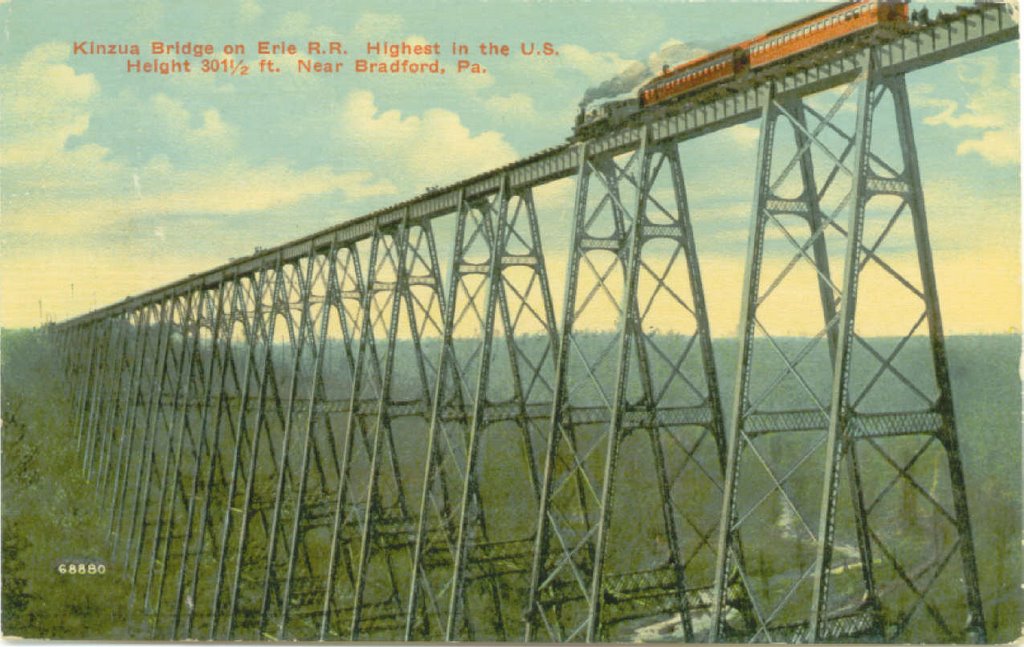
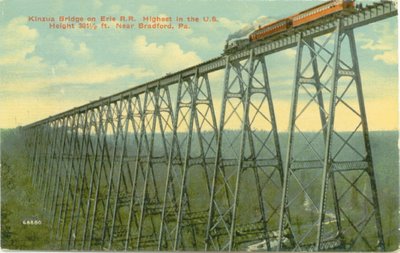
America's railroads, over the years, have built some astounding bridges and trestles in the process of getting from point A to point B. Some were built to last a thousand years, but others were spindly, rickity, temporary things that often collapsed, killing many folks on the process.

Just look at this one... it amazes me that people had the internal fortitude to even walk out on something like this, much less ride in a train consist weighing many tons. It's at least built of steel, so the chances of getting across alive was probably pretty good.
. This post card was unused, so I have no date to give you as to when it was purchased.
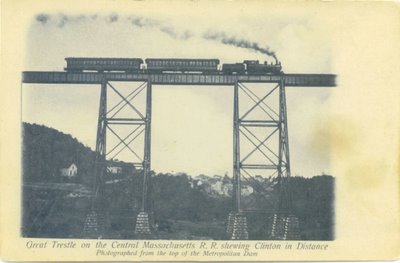
Look at this one. I'll bet a lot of railroad buffs will think this is a view of the famous AT&SF bridge across Canyon Diablo, but it isn't. It's a bridge of similar construction called "The Great Trestle" near Clinton, Mass., a short distance downriver from the Metropolitian Dam. It was built by the Central Massachusetts RR.


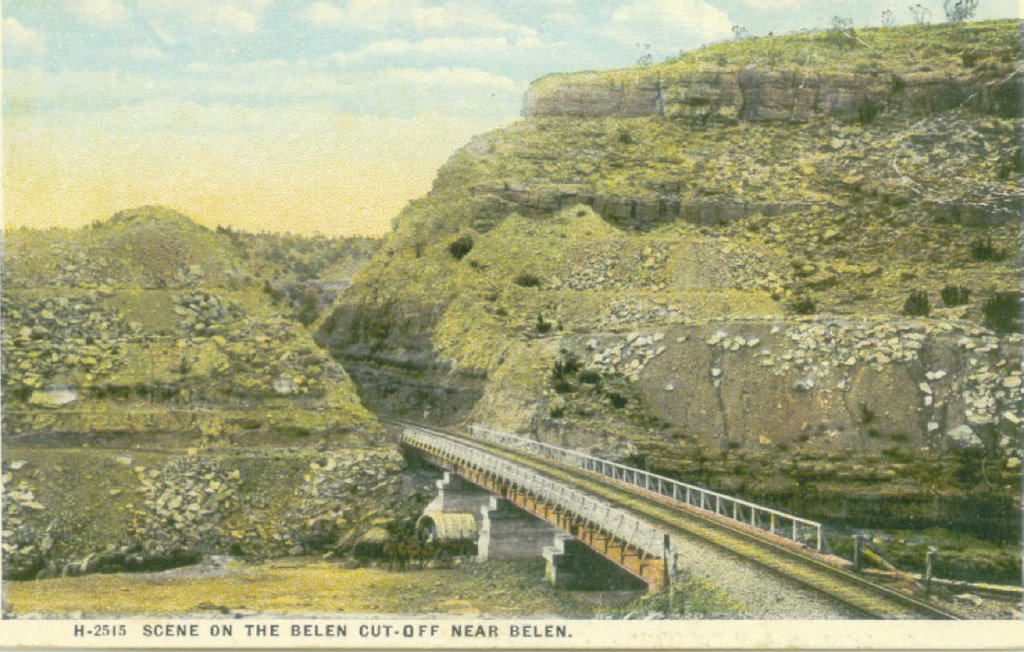
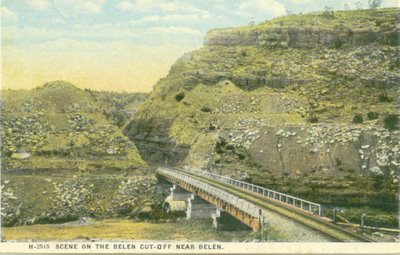
I like the below card for several reasons. I've been there, it's been postmarked, it actually has a covered wagon traveling under it, and most of all, it has a message to "Dear Data". And here I thought that Data never left the USS Enterprise.
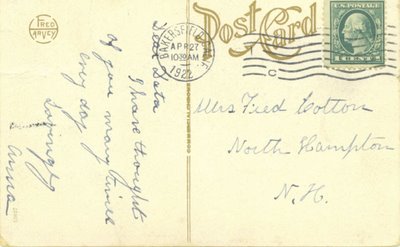
See? It actually says "Dear Data".

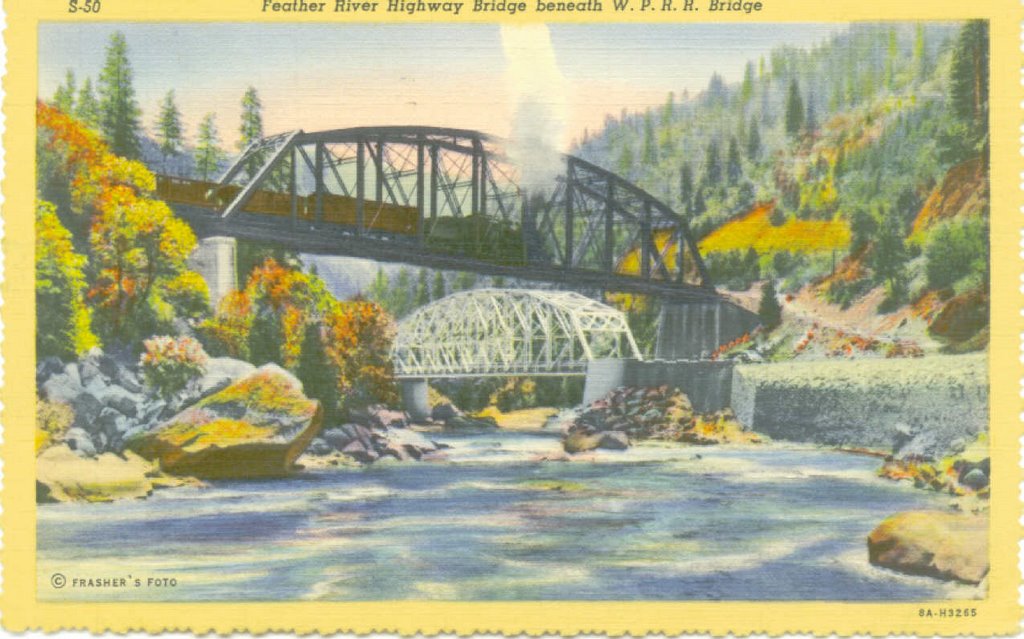
You'd think that out in the middle of nowhere there would be more than room enough so stacking bridges would not be necessary, but nooooo.... here's proof positive the exact opposite is the case.
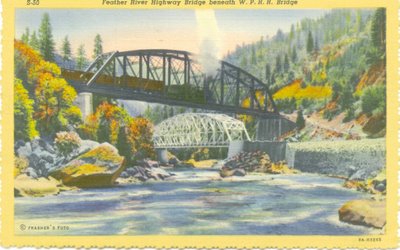

It's a fairly recent card, dated 1944.

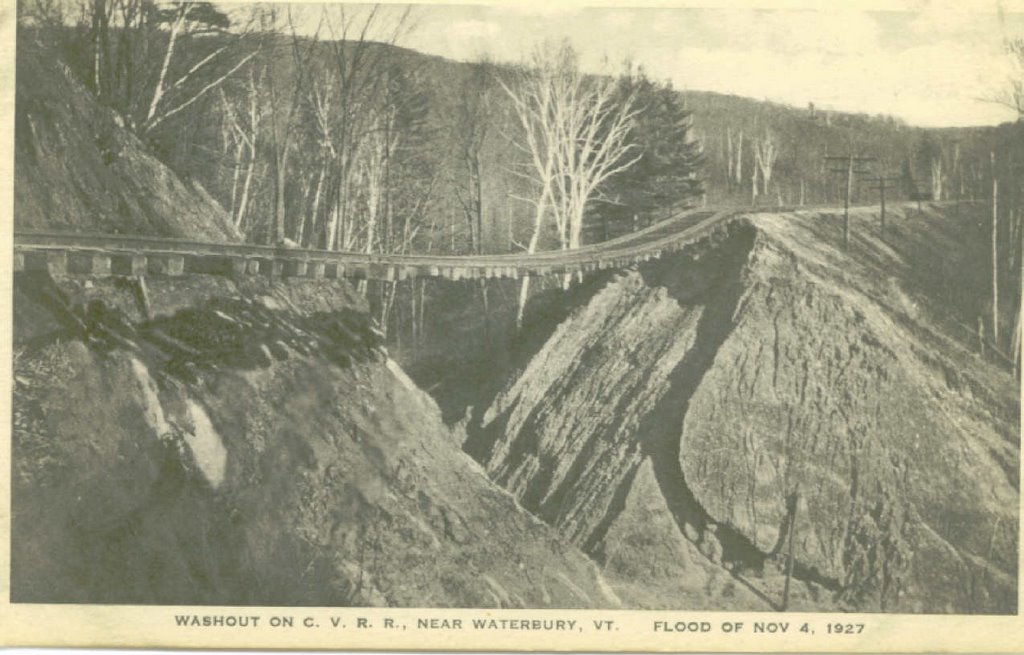
Somebody certainly overlooked something when they built this one: "It just don' rain that much round heah..."
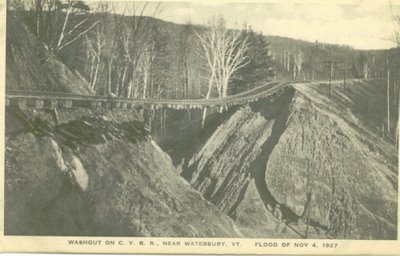
Bet you some of the locals at the time were daring each other to walk across the remains.

Bridge? What bridge? Must of been a day to remember...


I have stacks of postcards of bridges. It is difficult just to pick a few out. I also (re)discovered that I have postcards of stations, many long gone, cards showing the devastation caused by bombing in WW1, quite a few cards of the San Francisco fire, and other disasters around the world.

I'll pick out a few and post them... Eventually.